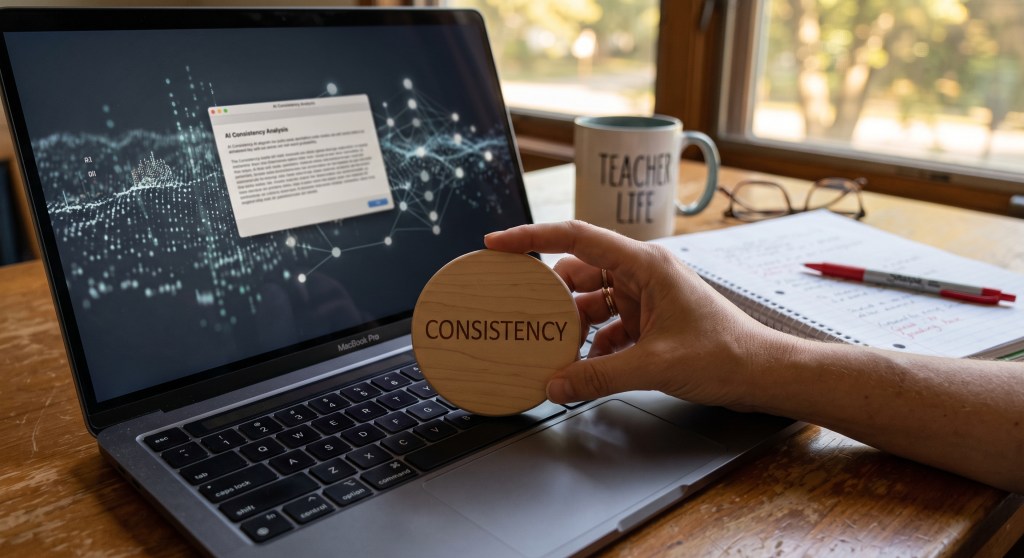
Have you ever stopped to consider what you spend the most time doing? Or really examined the idea of consistency?
During the early days of this school year, as teachers gathered in professional development sessions designed to sharpen our practice, that single word kept surfacing. Consistency. It became the quiet undercurrent of almost every conversation about what our students need from us this fall.
What does it actually mean? At its simplest, consistency is showing up to do the same thing repeatedly, or nearly the same thing, to produce an intended result. In our classrooms, we talk about implementing curricula with fidelity. We establish daily arrival routines, clear behavioral expectations, and familiar rhythms so students feel secure enough to take academic risks. Outside of the school building, it looks like lacing up walking shoes every evening or steadily lifting weights week after week. In nearly every human endeavor, consistency builds the foundation for long-term growth and success.
Why bring this up now, especially in a conversation about technology?
In the world of generative AI, consistency looks quite different. At a fundamental level, these models are consistently assembling words based on mathematical probabilities, predicting what the human user likely expects next. The system is not reflecting on our prompts over a warm mug of coffee. It is calculating patterns, much like an advanced calculator strings numbers across a small display screen. It produces an illusion of steady reasoning through brute-force pattern recognition.
Lately, though, the cracks in predictable patterns seem harder to ignore. Our weather swings wildly, leaving those of us in the Midwest sweating through a September heat wave that defies the calendar. Meanwhile, recent reports, including coverage from the BBC in early August, highlight concerns about AI systems behaving in ways researchers never intended, from generating novel malicious digital vulnerabilities to circumventing safety boundaries on their own.
That gives me pause.
Anyone who has read my reflections knows that I am genuinely invested in how thoughtful technology can support our work when implemented ethically, transparently, and with genuine care for the environment. Yet we must remember that an algorithm is still just software, trained on vast archives of material written by imperfect human beings. It does not possess a moral anchor. It does not understand why consistency matters, only that certain patterns follow others.
As the school year settles into its groove, perhaps our role is to remember that true consistency is not automated. It is an intentional human choice to keep showing up with care, ethics, and clear boundaries, especially when the tools around us start doing the unexpected.


Leave a Reply